
A hydraulic cylinder is a mechanical actuator that converts hydraulic pressure into linear force and motion. It is widely used in construction equipment, agricultural machinery, industrial presses, mining systems, marine equipment, and material handling machines.
Hydraulic cylinders allow machines to lift, push, pull, clamp, tilt, and move heavy loads with controlled force. They are commonly found in excavators, loaders, cranes, dump trucks, forklifts, and manufacturing equipment.
The basic working principle is simple: pressurized hydraulic fluid enters the cylinder barrel and pushes a piston, creating linear movement.
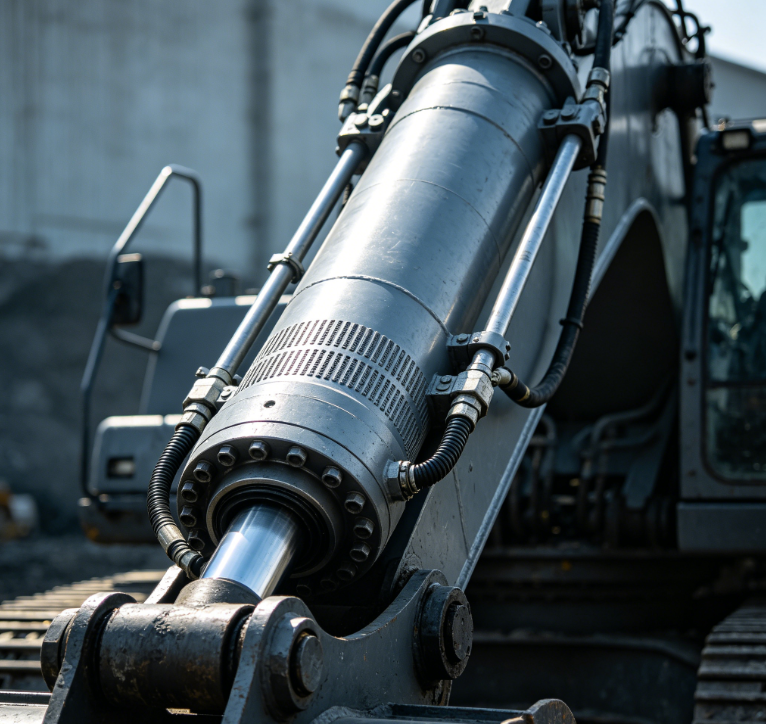
A hydraulic cylinder works by using incompressible hydraulic oil under pressure. The hydraulic fluid is delivered by a hydraulic pump through hoses and control valves.
Inside the cylinder, the oil pressure acts on the piston surface area, generating force according to the formula:Force=Pressure×AreaForce = Pressure \times AreaForce=Pressure×Area
F=P×AF = P \times AF=P×A
When oil enters one side of the cylinder, the piston rod extends or retracts depending on the flow direction.
This movement can be controlled precisely through hydraulic valves.
The barrel is the main body that contains hydraulic pressure.
The piston separates the internal chambers and transfers hydraulic force to motion.
The rod connects the piston to the external machine component.
Seals prevent hydraulic fluid leakage and maintain pressure.
The cylinder head and base cap close both ends of the barrel.
Hydraulic oil enters and exits through ports.
Hydraulic cylinders are available in different designs depending on application requirements.
A single acting hydraulic cylinder uses hydraulic pressure in only one direction. The return stroke usually relies on gravity, spring force, or external load.
A double acting hydraulic cylinder uses hydraulic pressure for both extension and retraction strokes.
Welded cylinders are hydraulic cylinders with end caps welded directly to the barrel instead of using tie rods.
These cylinders are widely used in mobile hydraulic equipment because of their compact structure and high durability.
| Feature | Tie Rod Cylinder | Welded Cylinder |
|---|---|---|
| Construction | Bolted tie rods | Welded body |
| Maintenance | Easier to service | More difficult |
| Size | Larger | Compact |
| Pressure Capability | Medium to high | High |
| Common Use | Industrial equipment | Mobile machinery |
Hydraulic cylinders are used across many industries.
The materials used affect durability, corrosion resistance, and operating life.
Different mounting styles are used depending on machine motion.
Proper mounting alignment helps reduce side loading and seal wear.
Usually caused by worn seals or damaged rod surfaces.
Internal leakage may allow the piston to move unintentionally.
Contaminated hydraulic oil can damage rod surfaces.
Excessive pressure or poor hydraulic design can increase oil temperature.
Incorrect seal material selection may shorten service life.
Regular maintenance improves reliability and operating life.
Contaminated hydraulic fluid is one of the main causes of cylinder wear.
Several factors should be considered when selecting a hydraulic cylinder.
Higher pressure systems generate more force.
Larger bore diameter increases output force.
Defines total travel distance.
Must match machine motion and installation space.
Corrosive or outdoor conditions may require special materials.
Consider both static and dynamic loads.
| Feature | Hydraulic Cylinder | Pneumatic Cylinder |
|---|---|---|
| Power Source | Hydraulic oil | Compressed air |
| Force Output | High | Lower |
| Precision | High | Moderate |
| Speed | Moderate | Fast |
| Common Use | Heavy equipment | Light automation |
Hydraulic cylinders are generally preferred for heavy-duty applications requiring large force output.
Modern hydraulic cylinder technology continues to evolve.
Digital monitoring systems are increasingly used for predictive maintenance.
A hydraulic cylinder converts hydraulic pressure into linear mechanical force and motion.
A single acting cylinder uses hydraulic pressure in one direction, while a double acting hydraulic cylinder uses pressure for both extension and retraction.
Welded cylinders are commonly used in construction, mining, forestry, and mobile hydraulic equipment because of their compact and durable design.
Common causes include worn seals, damaged piston rods, contaminated oil, and excessive operating pressure.
Service life depends on operating conditions, maintenance quality, pressure levels, and material selection. Proper maintenance can significantly extend lifespan.
Most systems use mineral-based hydraulic oil, though fire-resistant and biodegradable fluids are also available for specialized applications.
Hydraulic cylinders are essential components in modern industrial and mobile machinery. Whether using a single acting design for simple lifting or a double acting hydraulic cylinder for precise bidirectional control, these actuators provide reliable linear force in demanding environments.
From heavy-duty welded cylinders in construction equipment to industrial automation systems, hydraulic cylinders remain widely used because of their strength, efficiency, and durability. Proper selection, installation, and maintenance help improve performance and extend service life.


