
Hydraulic cylinders are among the most widely used actuators in modern hydraulic systems. They convert hydraulic energy into mechanical force and linear motion, allowing heavy equipment and industrial machinery to lift, push, pull, clamp, and position loads with precision.
From construction equipment and agricultural machinery to manufacturing systems and material handling equipment, hydraulic cylinders operate under demanding conditions while delivering high force output and reliable performance.
Understanding how a hydraulic cylinder is constructed helps engineers, maintenance personnel, and equipment operators select the right cylinder and maintain it properly. This guide explains the main components of a hydraulic cylinder, how they work together, and how different cylinder designs meet specific application requirements.
A hydraulic cylinder is a mechanical actuator that converts pressure hydraulic energy into linear motion. It consists of a sealed pressure chamber, a piston, and a piston rod that extends and retracts under hydraulic pressure.
When hydraulic fluid enters the cylinder, pressure builds inside the cylinder barrel and acts on the piston surface. The resulting force moves the piston and rod assembly, producing controlled movement.
Hydraulic cylinders are commonly classified as:
Both types are widely used across industrial and mobile hydraulic systems.
To understand the components, it helps to first understand how hydraulic cylinders operate.
The basic process includes:
The amount of force generated depends on:
Because liquids are nearly incompressible, hydraulic systems can generate substantial force while maintaining accurate control.
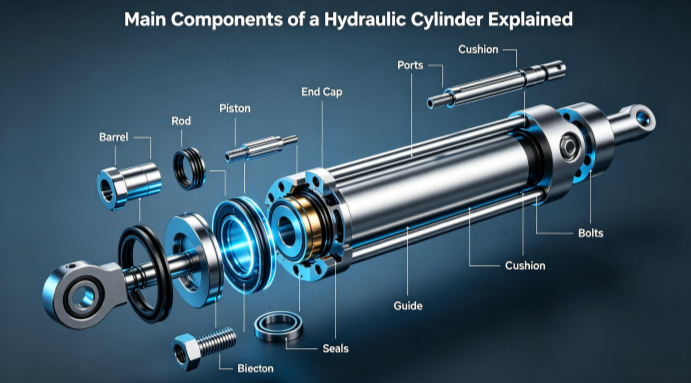
A hydraulic cylinder consists of several major components that work together to convert fluid pressure into mechanical movement.
The cylinder barrel forms the main body of the hydraulic cylinder.
It consists of a cylinder barrel manufactured from high-strength steel tubing designed to withstand internal pressure loads.
The barrel serves several functions:
The internal surface is precisely machined to reduce friction and promote smooth operation.
In heavy-duty applications, the barrel must withstand repeated pressure cycles over long service periods.
The piston separates the internal cylinder space into two chambers.
Hydraulic pressure acts on one side of the piston or both sides depending on the cylinder design.
The piston is typically attached to the piston rod and moves back and forth within the cylinder barrel.
Functions of the piston include:
The piston is often manufactured from steel, ductile iron, or other high strength materials.
The piston rod transfers the force generated inside the cylinder to the external load.
Since the rod is attached to the piston, both components move together during operation.
The piston rod must withstand:
Most hydraulic cylinder rods are chrome plated to improve wear resistance, reduce corrosion, and extend service life.
A chrome plated surface also helps protect rod seals from premature wear.
The cylinder head is located at the rod end of the cylinder.
It serves as the exit point for the piston rod while maintaining a pressure-tight seal.
The cylinder head typically contains:
Its functions include:
Because the rod moves continuously through the head assembly, proper sealing is essential for reliable operation.
The cylinder base closes the opposite end of the cylinder barrel.
Depending on the design, it may be:
The base helps contain hydraulic pressure and provides mounting points for the cylinder.
In many welded body cylinders, the cap is permanently welded to the barrel to improve structural integrity.
Hydraulic fluid acts as the power transmission medium.
Its functions include:
The quality and cleanliness of hydraulic fluid significantly affect cylinder performance and service life.
Contaminated fluid can damage seals, bearings, and internal surfaces.
Rod seals prevent hydraulic fluid from leaking where the piston rod exits the cylinder.
These seals are among the most important wear components within hydraulic cylinders.
Properly functioning rod seals help:
Seal material selection depends on:
Bearings and wear rings guide moving components inside the cylinder.
Their primary functions include:
Without proper guidance, side loading can accelerate wear and damage internal components.
Hydraulic cylinders generally fall into two categories.
Single acting cylinders use hydraulic pressure on only one side of the piston.
Fluid pressure extends the rod, while gravity, springs, or external forces return it.
Advantages include:
Common applications include:
A double acting hydraulic cylinder uses hydraulic pressure on both sides of the piston.
Fluid can be directed to either side of the piston, allowing powered extension and powered retraction.
Benefits include:
Double acting hydraulic cylinder designs are commonly found in:
One of the most common hydraulic cylinder construction methods involves welded body cylinders.
In welded body cylinders:
These cylinders are frequently used in mobile equipment where space is limited.
Tie-rod cylinders use external threaded rods to hold the assembly together.
They are often found in industrial hydraulic systems because maintenance and rebuilding are generally easier.
Side loading occurs when forces act perpendicular to the cylinder's intended direction of movement.
Excessive side loading can cause:
Proper mounting and alignment help minimize these stresses.
Cylinder designers often follow recommendations published by organizations such as the National Fluid Power Association (NFPA) when selecting mounting methods and sizing cylinders.
Hydraulic cylinders frequently operate in demanding environments.
Materials must provide:
Common materials include:
Chrome plated rods remain one of the most widely used solutions for extending service life in industrial and mobile equipment.
Hydraulic cylinders are used throughout modern industry, including:
In each application, hydraulic cylinders convert fluid power into controlled linear motion.
The primary components include the cylinder barrel, piston, piston rod, cylinder head, cylinder base, rod seals, bearings, and hydraulic fluid.
The piston rod transfers force generated inside the cylinder to an external load. It is attached to the piston and moves with it during operation.
Chrome plated rods offer improved wear resistance, corrosion protection, and smoother sealing performance, helping extend cylinder service life.
Single acting cylinders use hydraulic pressure on one side of the piston, while double acting cylinders use pressure on both sides to power extension and retraction.
Hydraulic cylinders operate by using pressurized hydraulic fluid to move a piston within a cylinder barrel, producing linear motion and force.
A pressure chamber is the sealed area inside the cylinder where hydraulic fluid builds pressure and acts on the piston surface.
Common causes include contamination, excessive pressure, side loading, improper installation, worn rods, and normal wear over time.
Welded body cylinders feature end caps welded directly to the cylinder barrel, creating a compact and robust construction commonly used in mobile equipment.
Side loading introduces forces that can bend the rod, increase bearing wear, damage seals, and reduce overall cylinder life.
Hydraulic cylinders are commonly manufactured using carbon steel, alloy steel, stainless steel, and chrome plated steel rods to provide high strength and durability.
Hydraulic cylinders may appear simple from the outside, but they contain a carefully engineered combination of components designed to convert hydraulic pressure into controlled linear motion. The cylinder barrel, piston, piston rod, cylinder head, rod seals, bearings, and hydraulic fluid all contribute to efficient operation.
Whether using single acting cylinders or a double acting hydraulic cylinder, understanding these components helps improve equipment selection, maintenance planning, and overall system performance. By choosing the appropriate cylinder design and maintaining proper operating conditions, hydraulic systems can deliver dependable service across a wide range of industrial and mobile applications.


