
Hydraulic cylinders convert pressurized hydraulic energy into linear force and motion, making them one of the most important components in any hydraulic system. Whether you're selecting a tie rod cylinder for industrial equipment or designing a complete fluid power system, understanding cylinder force helps ensure safe operation and proper equipment sizing.
This guide explains how hydraulic cylinder force is calculated, the factors that influence output, and common mistakes to avoid.
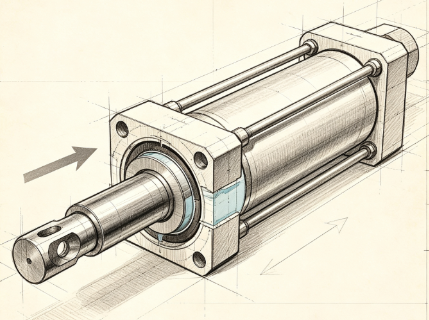
Hydraulic cylinder force is the pushing or pulling force produced when hydraulic fluid under pressure enters the cylinder barrel. The pressure acts on the piston surface, generating mechanical movement.
The amount of force depends primarily on:
The larger the piston area or the higher the pressure, the greater the force produced.
The basic equation is straightforward:
Force = Pressure × Effective Area
Where:
For SI units:
Force (N) = Pressure (Pa) × Area (m²)
For imperial units:
Force (lbf) = Pressure (psi) × Area (in²)
The piston area is calculated using the circle area formula.
Area = π × (Diameter² ÷ 4)
Example:
Cylinder bore = 80 mm
Area
= 3.1416 × 80² ÷ 4
= 5,026 mm²
= 0.005026 m²
Suppose the working pressure is 16 MPa.
Force
= 16,000,000 × 0.005026
= 80,416 N
≈ 80.4 kN
This is the extension force generated while the piston is moving forward.
Consider the following cylinder specifications:
| Specification | Value |
|---|---|
| Bore Diameter | 100 mm |
| Rod Diameter | 50 mm |
| Working Pressure | 20 MPa |
| Stroke Length | 500 mm |
Piston area
= π × 100² ÷ 4
= 7,854 mm²
= 0.007854 m²
Force
= 20,000,000 × 0.007854
= 157.1 kN
During retraction, the rod occupies part of the piston area.
Rod area
= π × 50² ÷ 4
= 1,963 mm²
Effective area
= 7,854 − 1,963
= 5,891 mm²
= 0.005891 m²
Retraction force
= 20,000,000 × 0.005891
= 117.8 kN
This explains why extension force is always higher than retraction force in most double acting cylinders.
A single acting cylinder receives hydraulic pressure on only one side of the piston.
Characteristics include:
These cylinders are often used for lifting tables, clamps, and simple pressing equipment.
A double acting cylinder uses hydraulic pressure on both sides of the piston.
Advantages include:
Most industrial rod cylinders are double acting because they provide continuous powered movement.
The piston rod reduces the effective piston area during retraction.
A larger rod means:
Designers balance rod strength with available pulling force when selecting rod cylinders.
Cylinder force increases directly with piston area.
For example:
| Bore | Approximate Relative Force |
|---|---|
| 50 mm | 1× |
| 80 mm | 2.56× |
| 100 mm | 4× |
Increasing bore diameter often produces a much larger increase in force than increasing pressure alone.
Pressure has a direct relationship with force.
If cylinder size remains unchanged:
However, every cylinder has a rated working pressure.
Operating above the specified rating may shorten service life, damage seals, or create safety risks.
Many people assume longer stroke length means greater force.
In reality:
Longer strokes may require:
The quality of hydraulic fluid influences overall cylinder performance.
Proper hydraulic fluid provides:
Contaminated fluid can reduce efficiency, increase wear, and affect the consistency of cylinder output.
Most piston rods are chrome plated.
Chrome plating helps provide:
A smooth chrome plated rod also supports stable sealing performance during repeated rod extending and retracting cycles.
A tie rod cylinder uses external tie rods to secure the cylinder head and end cap.
Benefits include:
Because of their modular design, tie rod cylinder products are commonly used in industrial machinery, material handling equipment, packaging lines, and manufacturing automation.
A typical cylinder working cycle follows these steps:
This process forms the foundation of many fluid power systems.
Theoretical calculations assume ideal conditions.
Actual output may be lower because of:
Engineers often include a safety factor when selecting cylinder size.
| Force | Approximate Value |
|---|---|
| 1 kN | 225 lbf |
| 10 kN | 1.02 tons |
| 100 kN | 10.2 tons |
| 200 kN | 20.4 tons |
Before choosing a cylinder, evaluate:
For many industrial applications, tie rod cylinder designs offer a practical combination of serviceability and performance.
Multiply hydraulic pressure by the effective piston area.
Force = Pressure × Area
For extension, use the full piston area. For retraction, subtract the rod area from the piston area.
In double acting cylinders, the piston rod occupies part of the piston area during retraction, reducing the effective area available for pressure.
No. Stroke length determines how far the piston travels, while force depends on piston area and pressure.
A tie rod cylinder uses external tie rods to hold the cylinder together, making maintenance and seal replacement easier. Welded cylinders have a more compact construction and are often used in mobile equipment and applications requiring higher structural rigidity.
Most rods are chrome plated to improve wear resistance, corrosion resistance, surface hardness, and seal life while maintaining smooth rod extending and retracting movement.
Only within the cylinder's rated working pressure. Exceeding the design pressure can damage seals, shorten component life, or create safety hazards.
Calculating hydraulic cylinder force starts with a simple formula: pressure multiplied by effective piston area. Accurate calculations also require attention to bore diameter, rod diameter, working pressure, and cylinder configuration. Whether selecting a single acting unit for simple lifting or a double acting tie rod cylinder for continuous industrial operation, understanding these relationships helps ensure the hydraulic system delivers the required linear force and motion efficiently and safely. Proper cylinder sizing, suitable hydraulic fluid, and components such as chrome plated rods all contribute to consistent performance and longer equipment life.


